Probabilistic Outcomes
Many outcomes are shaped by likelihoods rather than guarantees. Learners practice using probability language instead of treating every choice as certain or impossible.
Free and open educational curriculum
A free, open curriculum for helping learners make wiser choices under uncertainty.
18 weeks of hands-on activities in probability, cognitive shortcuts, game theory, and reflective problem solving. Strongest for ages 10–12, with a simplified path for ages 8–9 and extension prompts for ages 12–15.
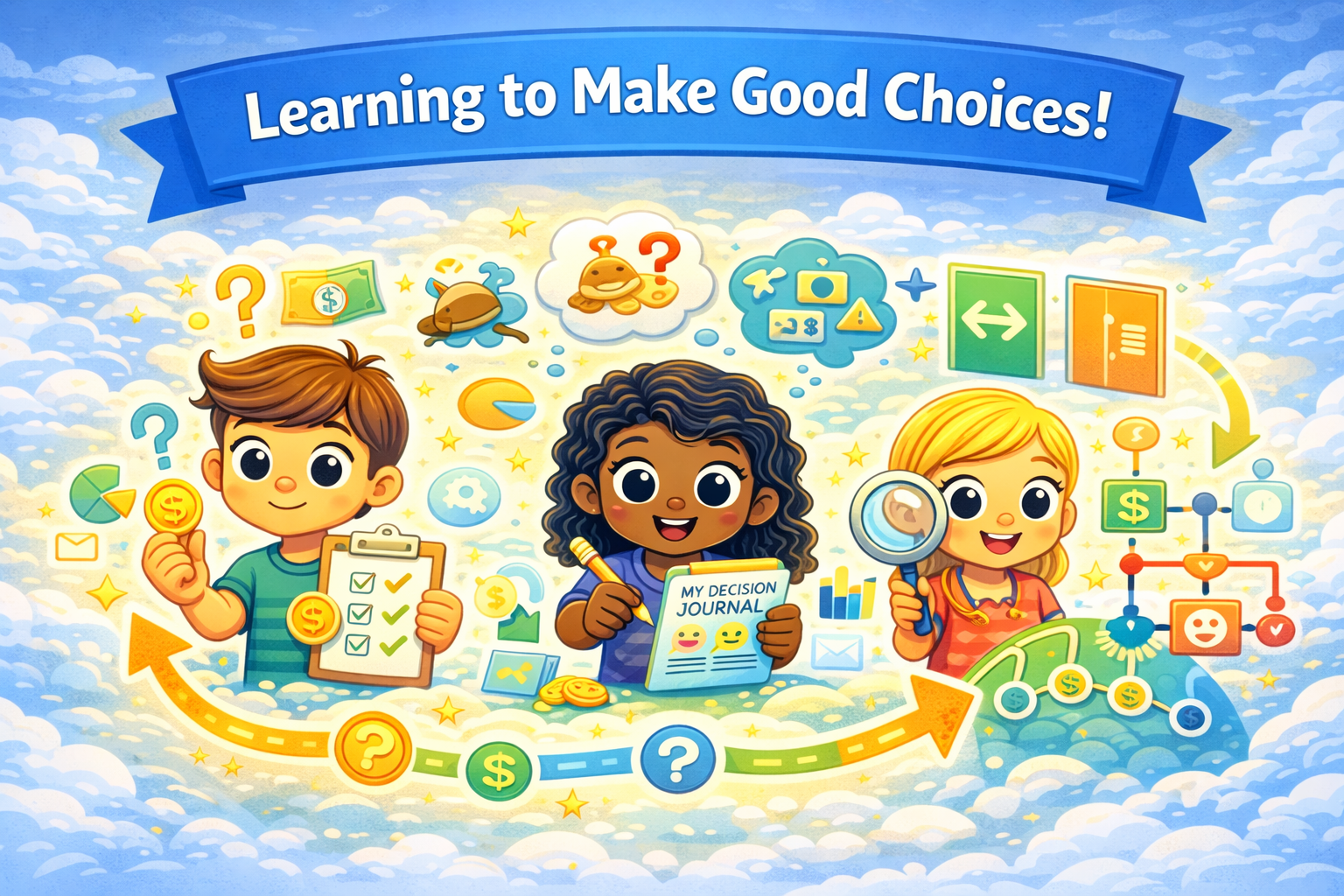
Decision Literacy for Kids helps educators and families teach learners how to think through choices, weigh evidence, notice trade-offs, and reflect on outcomes. The strongest fit is ages 10–12, with simpler supports for ages 8–9 and extension prompts for ages 12–15.
Plain-language summary: learners practice noticing choices, making predictions, checking what evidence they used, and reflecting on what happened.
Source note for facilitators: the curriculum uses widely taught ideas from probability, heuristics, metacognition, and reflective practice. These are presented as common patterns that often show up in real decisions.
Open-source curricula for children ages 8–12, designed to help kids understand the systems that shape modern life.
The curriculum is organized around a set of mental models that help students understand decision-making in practical, durable ways.
Many outcomes are shaped by likelihoods rather than guarantees. Learners practice using probability language instead of treating every choice as certain or impossible.
Our brains use mental shortcuts that often help but can mislead in some situations. Noticing those default patterns is the first step toward checking them.
Every choice carries a hidden price tag: the next-best option you did not pick. Learners make those invisible trade-offs easier to discuss.
More is not always better. Students learn that extra effort or extra research can help at first, then help less, and sometimes delay action without adding much value.
Many choices can be tested, measured, and improved. The course ends by helping learners design a protocol, try it, gather data, and revise it.
The learning progression moves from foundational ideas about luck and process into increasingly complex applications involving evidence, systems, and self-designed protocols.
This roadmap is presented as text so the full sequence stays readable with a screen reader or without relying on image text.
Weeks 1–4
Randomness, probability, process vs. outcome thinking, and the Decision Journal — building the foundation for everything that follows.
Weeks 5–8
Heuristics, loss aversion, sunk costs, and the framing effect — turning the lens inward to study the brain's default settings.
Weeks 9–11
Expected value, signal vs. noise, and the reversible/irreversible framework — quantitative tools for cutting through uncertainty.
Weeks 12–14
Ripple effects, the Prisoner's Dilemma, and the Tragedy of the Commons — expanding from "me" decisions to "us" decisions.
Weeks 15–18
Identify a real friction point, design a protocol, test it with data, and iterate — applying every tool to a genuine personal challenge.
Begin with Week 1 and help learners build a repeatable process for making, discussing, and revising decisions thoughtfully.
Found a mistake or have a suggestion? Open an issue on GitHub.
Version 1.0
This curriculum is an open project and will continue to improve as teachers and families use it.